

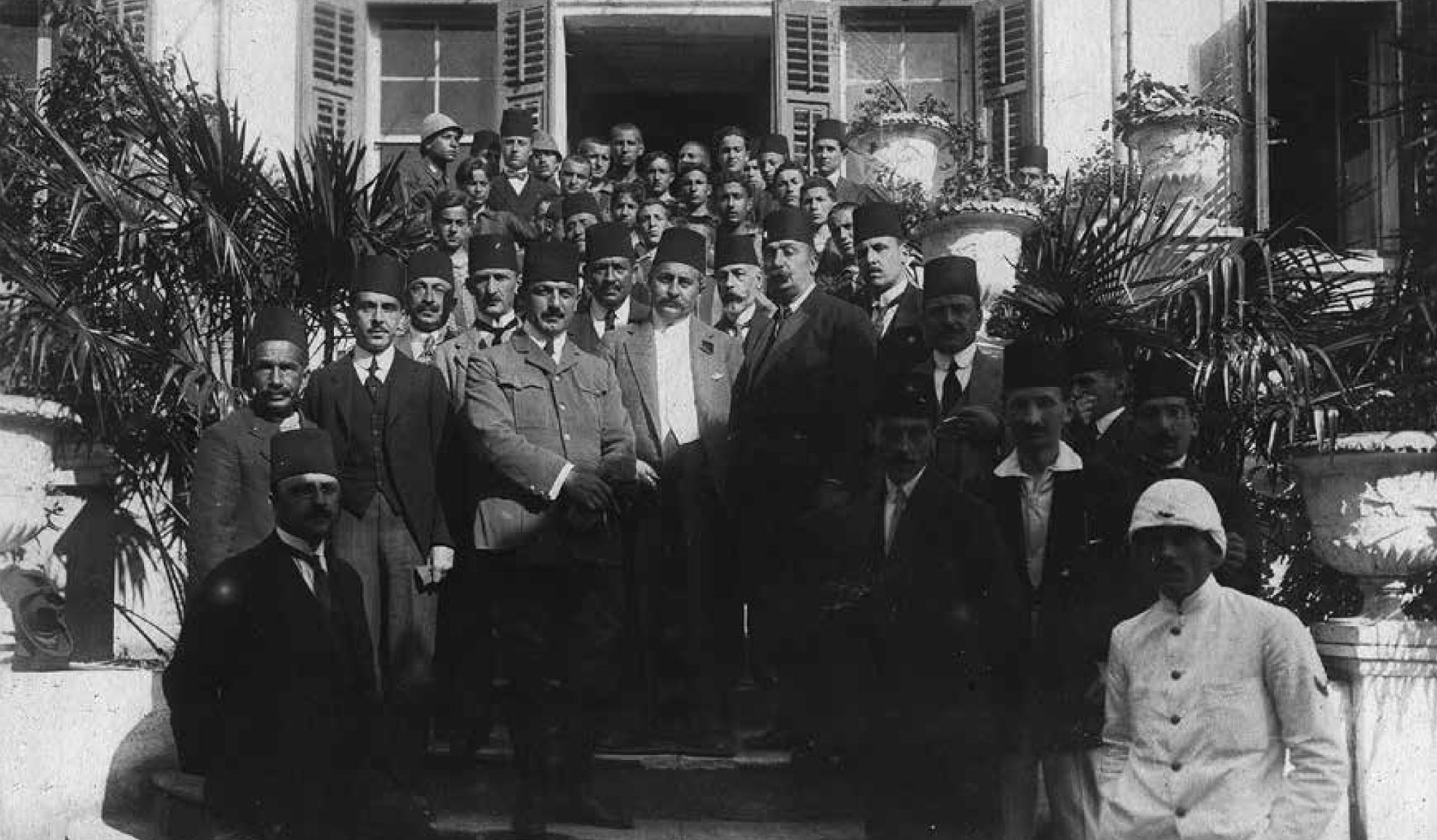
One hundred years ago, the 1924 Olympics were again in Paris. An opportunity had arisen for the new Republic of Türkiye, which had not even been officially established for a year, to make itself known to the world, and the sports community was mobilized, getting ready to carry the national jersey to the international arena for the first time. Ali Sami Yen (1886-1951) was appointed as the head of the delegation and preparations for the journey began.
Ali Sami Yen, who founded the Galatasaray Football Club in 1905, incorporated many sports branches into the club and gathered all sports clubs under a union, had also made important initiatives in the field of maritime. He continued his leadership in the development of amateur sailing and the spread of maritime culture in his country by creating the Galatasaray Maritime Museum at the Beau Rivage mansion in Kalamış Bay in 1913. There is no doubt that he was influenced by the intellectual personality of his father, whom he lost at an early age. He was the son of Şemsettin Sami, an important figure in the world of literature and the author of the first Turkish novel, encyclopedia and dictionary. He studied at Mektebi Sultani and grew up in a family with a European lifestyle. The fact that he devoted most of his life to sports and accomplished many firsts led to his appointment as the founding president of the Turkish Training Associations Alliance, which was established with the republic. This position led him to his first Olympic experience and then to the presidency of the National Olympic Committee between 1926 and 1931.
Upon the government’s decision to participate in the 1924 Paris Olympics, the first Turkish Olympic delegation was determined and it was decided to send 32 athletes from five branches (athletics, football, wrestling, weightlifting, cycling) to Paris.
Although he was an Albanian immigrant and came from a family far from maritime culture, he was interested in the sea during his childhood years on the Bosphorus. Under the influence of Abidin Daver, one of his friends in the first squad of Galatasaray, he became interested in sailing and worked as an instructor at the Heybeliada Naval School during the First World War. Those years were reflected in his memoirs as follows: “The outbreak of the First World War in 1914 led to the start of a new sport. This was sailing. All the cutters and skiffs were confiscated. The Naval Society distributed them to clubs to spread water sports. We threw ourselves into this sport with all our love, excited to take possession of boats that we could not otherwise own. I prepared for the close-range captain’s exam and learned seamanship and flag communication at sea. I learned all the work to be done on cutters and created a small maritime museum.”
The Galatasaray Maritime Museum, which was opened with the support of Cemal Pasha, the Minister of Navy, did not last long as the building was confiscated during the occupation of Istanbul in 1918, but its collection was preserved at Galatasaray High School and can still be seen today at the Galatasaray museums in Beyoğlu and Rams Arena.
The athletes of the club founded by Ali Sami Yen first got their hands on water sports in 1914 by participating in rowing races in Moda Bay. In 1917, they won the sailing race between Fenerbahçe and Kınalıada on the cutter İnci, and the idea for the museum was born then. “I was often wandering around the caulking yard to complete the missing parts of the cutter. One day I managed to buy a deep water sounder sold by an old sailor for 15 kurus. It was a very old outdated device. As I cleaned and polished it, it showed itself on the table in our shipping room. The eagerness to bring a second instrument with it gradually led to the emergence of our maritime museum.”
It was not only the museum that was emerging. On the other hand, different sports branches were spreading among the youth, and a generation of complete athletes working in different disciplines at the same time was born. This generation would finally devote themselves to sports with the peace that was achieved in 1923, and they would be part of the first Olympic delegation.
1923 marked a new beginning for Türkiye. The parliament in Ankara, which had been fighting for independence for four years, achieved peace, declared the republic, and gained its independence. The multidimensional modernization initiative that Atatürk envisioned for the Republic of Türkiye, which he founded in 1923, aimed not only at political, economic and industrial reforms, but also at bringing society together with universal culture in every field. Sports institutions, symbolized by the saying “I like athletes who are intelligent, agile and moral”, were structured simultaneously with the new constitutional parliamentary state. Atatürk, who believed in the power of sports to gain international recognition, attached particular importance to the representation of his country at the 1924 Paris Olympics and wanted to show the new modern face of his country to the world. Baron Pierre de Coubertin, the founder of the modern Olympics, had already established relations with Türkiye and accepted Selim Sırrı Tarcan (1874-1957), a Turkish sportsman who shared his dream, as a member of the International Olympic Committee (1908-1930). Thus, the country’s Olympic adventure was started by two athletes who studied at the same school and were introduced to sports by the same person (Faik Üstünidman). In addition to his efforts for the participation of Turkish athletes in the organization, Selim Sırrı Tarcan also served as the president of the National Olympic Committee (1922-1927).
Citius, Altius, Fortius
In the 8th century BC, sporting encounters based on the ideal of physical and mental harmony, gentlemanly competition, good rivalry and holy truce became a regularly celebrated ritual at the temple of Olympia on the Peloponnesian peninsula. No one spoke of Olympia until nearly two thousand years later when Pierre de Coubertin was inspired to overcome physical strength by striving to win a crown of olive branches.
Coubertin’s idea of organizing an international sports event in 1892 gave birth to the International Olympic Committee, a group of 13 countries. The first Olympic was organized in Athens in 1896, referring to antiquity. Financing was provided by the fact that it was a side event of the World Trade Fair (EXPO).
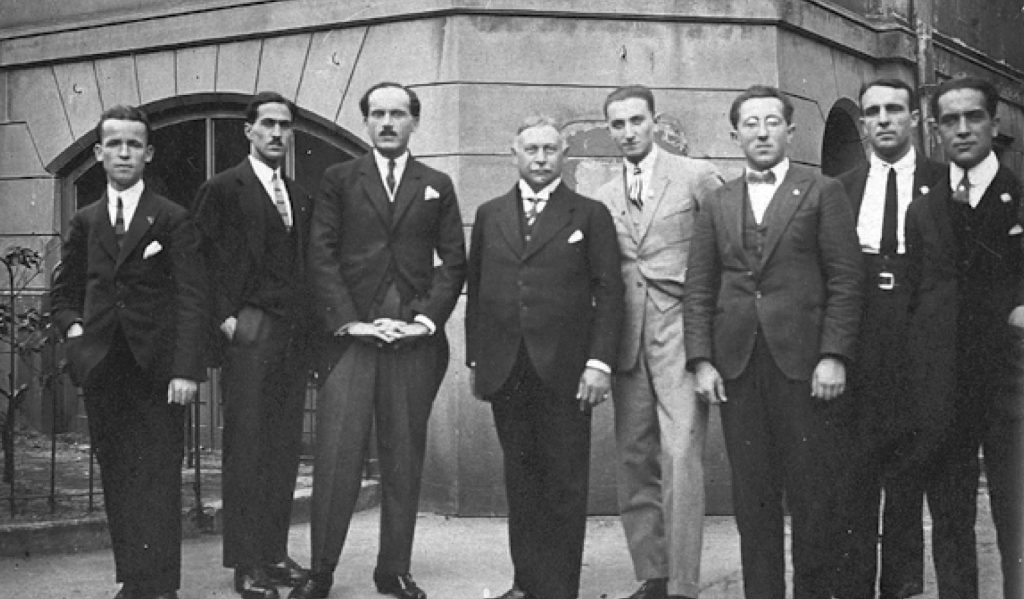
“Citius, Altius, Fortius” (Faster, Higher, Stronger)… The motto of the Olympics consisted of these three words. The rings on the flag of each country, symbolizing the continents by carrying common colors, were introduced in 1920. Until the 1924 Paris Olympics, there had only been sporadic individual participation from the common people, but Türkiye was officially joining the olympic system for the first time with national teams. Nihat Bekdik, a member of the football team, was also a boxer, rower and athlete. A few years later, he would enter the Naval Academy and would later be among the first group of Turkish sailors to cross the Atlantic Ocean. That year, with the Turkish national football team, he wore the jersey with the crescent star stripe, whose design principles had not changed for a hundred years, for the first time abroad in Paris.
As a result of the selections made upon the government’s decision to participate in the 1924 Paris Olympics, the first Turkish Olympic delegation was determined and it was decided to send 32 athletes from five branches (athletics, football, wrestling, weightlifting, cycling) to Paris. Unvan Tayfuroğlu would carry the national flag at the opening ceremony.
The French-flagged Jacques Fresine was a cargo ship carrying the Turkish delegation from Istanbul to Marseille. Therefore, the Turkish delegation had a very uncomfortable voyage during the four days in the Mediterranean, surviving a storm and even having difficulty finding food for the last two days. After Marseille, it took them a total of ten days to reach Paris by train via Lyon. In the end, the Turkish athletes, football team and wrestlers were eliminated in the first round of the first Olympic participation in 1924. The cyclists could not compete because their bicycles did not arrive at customs on time. In his letter of thanks to Prime Minister İsmet Pasha, Selim Sırrı Tarcan stated that it would be impossible to take first place from countries that had made sports a national principle. This result was deemed normal and it was decided to keep trying. After returning empty-handed from the 1928 Amsterdam Olympics, Türkiye focused on success in the Balkans and Europe in Olympic sports. Sports education was spread to the base with schools at all levels and traditional branches such as wrestling, equestrianism and archery were modernized. As a result of these efforts, Türkiye won its first Olympic medal at the 1936 Berlin Olympics. With Yaşar Erkan’s gold medal in the 61 kg Greco-Roman and Ahmet Kireççi’s bronze medal in the 79 kg freestyle, the claim in wrestling began. The international rankings achieved by combining the traditional oil wrestling tradition with universal conditions gave birth to the saying “strong like a Turk” and made Türkiye the country with the highest number of Olympic medals in this branch. Olympic successes further popularized the branch, and medal winners began to be welcomed and rewarded with ceremonies.
One hundred years ago, the first Turkish Olympic delegation to Paris was honored with a fiftieth anniversary plaque in 1974 for being the first Turkish athletes to wear the national jersey abroad. Another half century has passed since that day, and this year, while Türkiye was chasing medals in Paris, it also celebrated the centenary of its Olympic history at the Istanbul House in the Palais Galliera.


