© 2026 SIRENA YACHTS. ALL RIGHTS RESERVED.

The first Sirena 48 Coupé Hybrid yacht is ready for its world launch at the Cannes Yachting Festival 2024. With innovative model features, sleek coupé design and a high-performance hybrid powertrain, the Sirena 48 Coupé Hybrid will herald a more sustainable era of yachting. With an innovation that provides silent power and cuts exhaust emissions on demand, Sirena Yachts is pushing the boundaries of green yachting.
Elegance meets innovation
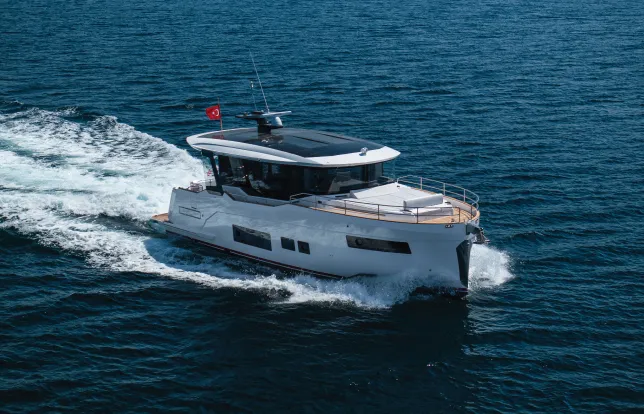
This core DNA of the regular Sirena 48 model remains untouched in the new hybrid version, and makes the three-cabin yacht as appealing as ever in the small-to-mid-sized yacht market. The difference is that the open-air flybridge has been replaced by a coupé-style coach roof beautifully curved and studded with glass and solar panels. The coupé look is so elegant that Sirena is anticipating de-mand from owners specifying conventional propulsion packages as well.
Not only does this hardtop give the Sirena 48 a sportier exterior, but it also brings natural light flooding into the saloon area below, which forms the social heart of the boat. Even more importantly, it reduces the weight and windage of the yacht, improving the performance and range of the electric propulsion. Solar panels set into the coach roof help to prolong the operating range of the yacht under electric power alone.
Silent power
With sleek new coupé styling and a high-performance serial hybrid power train, Sirena Yachts is making a bold statement about more sustainable yachting. Silent power on demand without exhaust emissions is finally a reality in this class.
When the Sirena 48 was launched last year, critics were beguiled by its good looks and smart use of generous interior volumes. This core DNA remains untouched in the new hybrid version, and makes the three-cabin yacht as appealing as ever in the small-to-mid-sized yacht market. Not only does this hardtop give the Sirena 48 a sportier exterior, but it also brings natural light flooding into the saloon area below, which forms the social heart of the boat. Even more importantly, it reduces the weight and windage of the yacht, improving the performance and range of the electric propulsion. Solar panels set into the coach roof help to prolong the operating range of the yacht under electric power alone.
“The hardtop design is particularly well suited to the hybrid drive system, and offers a remarkable solution in terms of aesthetics while maximising the number of solar panels,” says Sirena Yachts CEO Cagin Genc. “At Sirena Marine, we have been work- Elegance meets innovation Silent power A MASTERPIECE OF RESPECT TO THE SEA: SIRENA 48 COUPE’ HYBRID 21 ing hard to integrate a robust, meaningful hybrid option for some time. And though we are starting with our latest 48ft yacht model, we are able to implement the solution on any of the yachts in our range, which runs up to 88ft.”
Driven by twin 213kW electric motors, the Sirena 48 hybrid tops out at a speed of 14 knots. In silent electric mode it can draw power directly from the large battery bank to cover up to 30 nautical miles before switching on the variable speed generators. In this way, the boat can make a low-profile depar-ture from the harbour or anchorage without the noise and emissions of a diesel system.
For longer range and more speed, the two highly efficient generators kick in to produce the electricity needed to drive the boat and recharge the batteries. They do this much more effectively than a diesel engine, and can be positioned independently of the propellers, reducing noise and vibration to a whisper. When the boat finally reaches its destination, the batteries are full again allowing you to overnight in total silence – no need to start the generators for more than eight hours, even with the aircon run-ning and the galley or AV systems in use.
By integrating hybrid solutions from e-Motion, Sirena Marine is bringing many new benefits to its yachts,” says Genc. “Not only can they offer quieter and more comfortable cruising at anchor and un-der way – we estimate that a hybrid system can reduce fuel consumption by up to 35 per cent and cut maintenance costs by 10-15 per cent. With less noise and fewer emissions, a hybrid Sirena Yacht has a lower impact on the environment.”
Choice is core to the Sirena Yachts concept, with a range of layouts inside and out, different styling choices and equipment levels. Just as the hybrid propulsion option is available across all models, so the coupé design can be applied to conventionally powered models.
7 reasons to choose Sirena 48 Hybrid
1. What is the peak output rating of the solar panels on the roof and is this mainly for charging the house batteries or is it enough to actually charge the main batteries and/or drive the motors them-selves?
The solar panels on the roof, with a peak output rating of 4.2 kWp and 170A, are primarily for charging house batteries. The estimated charge time for only the house batteries is approximately 2.5 hours. It’s important to note that the actual charge time may vary based on factors such as sunlight conditions, weather, sunlight duration, and the current state of charge of the batteries.
2. What is the estimated top speed of the hybrid boat using both the generators and the battery pack?
The system is a serial hybrid system and can make 14 knots with generator or battery. There is no increase in speed by additional batteries effects to the generator. While cruising at maximum speed with a battery takes less time (15-20 minutes), this time is longer with generators.
3. What is the standard battery pack’s kWh in total?
Each battery pack is 39.1 kWh. Standart boat have two packages (2×39.1 = 78.2 kWh.). There is the option to add two more packages to obtain a total battery capacity of 78.2×2 = 156.4 kWh.
4. In the standard propulsion table what does the “Full diesel general cruise” mean and how can 120 hours use at 50L/H only equate to 100nm cruised?
Especially port entrances and exits, bay/coast entrances, maneuvers, low speeds, etc. mixed use is considered. It is anticipated that this type of usage will occur at approximately 100 Nm in the specified cruise period. The time required to travel a distance of 100 Nm was calculated as hours in two differ-ent propulsion systems. While the average time for diesel use is 120 hours, it is calculated to be 80 hours for electricity use.
5. Why are there 120 hours of full diesel general cruise and 22 hours of 6.5 knots for the diesel version but 80 and 40 hours for the hybrid?
The average mixed use time for 100 Nm travel was examined. It has been assumpted that the 40- hour battery capacity created by cruising and fast charging in diesel electric mode will be transferred to use at average speeds. In this 40 hours, 270 Nm range can be achieved at 6.5 knots. The energy required for cruising at 6.5 knots is obtained as additional gain at hybrid version. On the other hand, extra en-ergy is required to cruise at 6.5 knots in the standard propulsion system. It is assumed that cruising takes approximately half the time in electric mode (nearly 22 hours). If the extra 270 Nm gained in the electrical system were targeted, more fuel would have to be used to reach 270 Nm in the standard SIRENA YACHTS 7 reasons to choose Sirena 48 Hybrid A MASTERPIECE OF RESPECT TO THE SEA: SIRENA 48 COUPE’ HYBRID 23 propulsion system, thus CO2’d would increase. For this reason, it was assumed that approximately half of the 40-hour cruise in electric mode would be performed in standard propulsion(nearly 20-22 hours) as cover.
6. The number of generator engine hours for the standard propulsion boat assumes the generator is running 24 hours a day for 60 days non stop and 30 days for 12 hours overnight. Boats spend quite a lot of the time either on shorepower in a marina, cruising on its main engines without the generator running and using its conventional house batteries without the generator running.
Our aim is to compare two different propulsion systems at the similar level with a scenario. In the hybrid propulsion system, it is possible to charge from the marina and sail back without using almost any generators or using much less. The hybrid version is also assumed to run its generators.
7. Are all the full electric figures, including the cost saving, based on the boat’s batteries being charged by a combination of the boat’s own solar panels and 45 hours of generator fast charging or does it assume that the batteries are being charged on shorepower that is carbon neutral and free?
It is assumed to be used combinatorially as mentioned.
Efficient hybrid power brings silent performance to the Sirena 48
- Serial hybrid propulsion option for the Sirena 48
- Superstructure remodelled to offer a sleek coupé
- Solar panels integrated
- Silent and emission-free for up to 8 hours
- Range of customisation options for crew or owneroperation